Hi all, new to this forum but long time Micro:bit user, and I have a problem!
I am a teacher trying to do a project with one of my classes where students create a device that can automatically water a tomato plant based on soil moisture data collected from a soil moisture sensor. I am in the process of designing the system, but I am running into some roadblocks. I am not an expert in electronics by any means, so this is what I have come up with based on some basic online research:
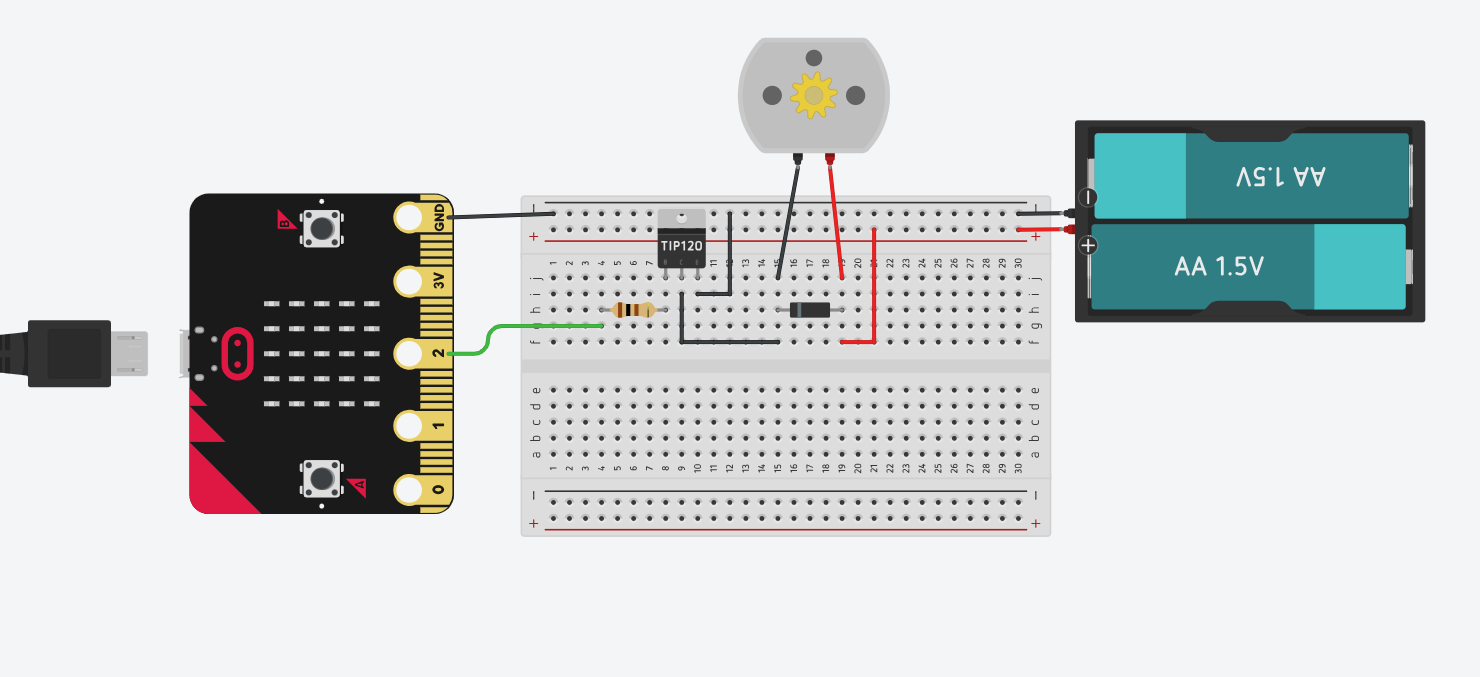
The motor represents the 3V pumps we will use to transfer the water from a reservoir into the plant. In the final circuit the Micro:bit will be powered with an external battery pack, and an additional battery pack will be hooked into the breadboard to provide slightly higher voltage for the pump. The TIP120 transistor is supposed to allow pin 2 on my Micro:bit to activate the pump by increasing the current. If I hook the pump straight up to the pin it will not turn on. I suspect the Micro:bit cannot supply enough current (or perhaps voltage) to do this. From what I found online, the diode across the pump prevents blowback that could damage the pump when it is turned off, but I am not sure if that is totally necessary. My TinkerCAD works, but when I create this circuit in real life with the same components it does not work.
I know that I am misunderstanding or missing something, so please help me figure out what that missing link is!
Link to my TinkerCAD: https://www.tinkercad.com/things/lXmA4c1Uzau-tomato-plant-watering-system