Still coding! There’s been a pretty big unofficial game jam running around made by copysprite. Altho the growth rate of the chatting area is still concerning 
2 Likes
wuht??
1 Like
air why is el char char there.
2 Likes
I always use these in switch commands. I never really use the continue though.
1 Like
I love celeste! I think I was doing the C sides plus Farewell (the one that introduces all that new tech that reminds me so much of towerfall) when I finally stopped, as I didn’t want to get RSI when I am older. I played it on the ps5. Have you played celeste classic before? I loved that game, got my runs down to like 9m or something silly, a great amount of fun. I played in on a device called the Retroid, which is basically a small handheld gaming device that can be used to play old-new games. https://maddymakesgamesinc.itch.io/celesteclassic if you are interested in the one that works on pc
1 Like
LOVE the Pico-8. Retroid looks like a really cool device, too!
2 Likes
Actually never mind, I played it again and died a whole bunch, I think my old runs were down to like 5-6m
1 Like
Maybe it’s a good sign the amount of users when the chatting area start was low making it a desolate place but now this topic is bustling maybe the chatting area posts per month is a sign of the forums activity in total
2 Likes
I use duck when any post was made in the bird jam
1 Like
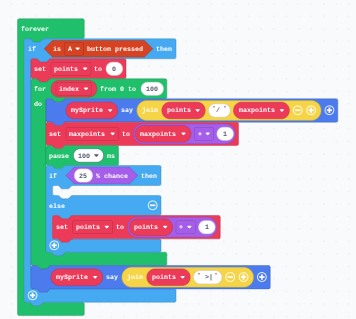
Break blocks break from the loop. When encountered in the program, it will ignore the rest of the code inside the loop. It will only ignore the code from the innermost loop it is in. There’s a 1 in 4 chance the outlined code will be ignored in Figure 1. The index loop will end, and the code will be continued right after the end of the loop.
Continue blocks are similar to break blocks except when they ignore the rest of its current loop, it will only do that; the loop keeps going. The same chances will apply to figure 2, so the outlined code will be ignored, but the index loop will still repeat since the code will be continued right before the loop ends. Figure 3 is what the code would be if it didn’t have the continue block.
(TL;DR) Continue blocks ignore the rest of the code in the loop, but the loop continues and break blocks ignore the rest of the code in the loop, but the loop doesn’t continue.
Press (A) to play the difference.
Figure 1.

Figure 2.

Figure 3.
Also, here’s some music.
Cavern Fork
5 Likes
I did this at 2 am.
ZZZZZzzzzzzzzzzzzzzzzzzzzzzzzzzzzzz......
3 Likes
Noth need to be placed in a loop. This can be a “repeat 4 times” loop for exaple. A “break” block stops the loop and everything inside of it and instantly jumps to the block below the loop block.
“Continue” is bit harded to explain, but it skips all the blocks that are under it that are still inside the loop, but the loop continues.
I cant think of an example that isnt like 10 times more complicated than the block itself.
2 Likes
break exits the loop, while continue goes to the next iteration. In this example, when you choose “break”, it will not show anything after the 0, because the loop has ended. When you select “continue”, you can see that it does everything exept the 0’s. To understand this better, look at the code!
2 Likes
I think they’re talking about “Haiku the Robot”
2 Likes
They weren’t talking about Celeste, they were talking about:
2 Likes
I’m talking about Haiku the Robot.
3 Likes

Oo wait let me try
 - Like
 - Yes/Me too
 - XD
 - gasp!
 - yippee!!
 -
 or happy
 -
 or disagree or HOW DARE YOU
6 Likes
I think i use break. I use it to stop a repeat # of times block if a condition is met(like the flappy bird falling into the void after hitting an object)
1 Like
I use them in Javascript mostly
break is used in a switch/case statement to specify the end of the case or whatever, like this:
let var = randint(0,10)
switch(var) {
    case 0:
        //run code here if var == 0
        break
    case 1:
        //run code for var == 1
        break
    //etc.
switch/case is basically an if statement, but because the condition doesn’t enclose its code in brackets ({}) you have to use break or it will run all the conditions’ code.
continue is used to skip out of a loop (like a for loop for example) so you can stop running it early, like this:
let var = randint(0,10)
let returnNum = 0

for (let i = 0; i < 10; i++) {
    if (i == var) {
        //Found the value of Var, so stop running the extra code
        returnNum = i
        continue
    }
}

console.log("var = " + returnNum)
If for example var is only 2, then it’s not optimal to run this loop another 8 times when you’ve already found the value, so you’d use continue to exit the function early. In this example it doesn’t really matter (and you could just log var initially anyway) but for more code-heavy calculations and stuff you don’t want to run the same thing over and over if you don’t need to.
3 Likes