@AlexTheGoober63 is this you? https://www.youtube.com/watch?v=pT4xDuy2rLg
1 Like
My man, you ain’t a McKinsey Consultant or my personal publisher/editor. Don’t you force whatever I spend my time yapping about.
1 Like
PREFACE
Alright, so I know that, in the past, I stated that I would stick to a monthly schedule for this type of stuff when it comes to me yapping about impressive software-engineering stuff. However, as it turns out, I finished this essay much faster than I previously anticipated, and I got a little impatient, so here we are.
Anyways, for this installment, I took heavy inspiration from a very specific and specialized field in finance called Quant. Quant essentially involves using advanced mathematics, statistics, and algorithms to analyze the markets to help make profitable investments. In this case, the essay will be talking about a specific branch in that field.
So without further ado, let’s get into it.
AN ESSAY ABOUT HIGH-FREQUENCY TRADING (HFT)
There are thousands of financial institutions stationed across the globe. Many of these firms are doomed to fail within the span of the first few years. But the successful ones pull hundreds of thousands, millions, if not billions, of USD in 1 year alone.
Quite a large chunk of that money is made through the act of “trading,” which is the buying/selling of liquid assets, typically done in high volumes. A lot of the assets that these finance firms trade include, but are not limited to, stocks, bonds, derivatives, and commodities (e.g., oil). Lots of finance-related stuff is being moved around for lots of money in return.

(The stereotypical chaotic trading floor at Wall Street as shown in movies)
A single trade is usually done in the span of mere seconds, where being too late can result in you losing your firm a lot of money, making trading quite a stressful job. But there exists a niche sector in the field of trading in which the programs and machines do all the trading themselves at way faster speeds compared to seconds. There are entire firms made for just this one idea. This niche is otherwise known as High-Frequency Trading, or just HFT as an acronym.
HFT performs the trades itself in the span of mere microseconds and nanoseconds. To emphasise just how fast that is, a microsecond accounts for 1/1,000,000 of a second, and a nanosecond accounts for 1/1,000,000,000 of a second. One millisecond (1/1000 of a second) passing by is way too fast for even an F1 driver to process, but this is on a whole other level of speed.

(A couple of well-known HFT firms)
But how do the HFT algorithms really work in that case? A lot of the code for HFT systems is quite secret and heavily guarded, which does make a lot of sense; firms might not want to reveal the secret stuff that consistently makes them filthy rich on an annual basis. However, we can get the logical structure down. It’s rather common for all the firms out there.
First things first, the system finds market data compiled from a variety of sources. The market data is mainly composed of pending buy/sell trades (order book), like someone who wants to purchase a bunch of stock. A lot of this market data is not something that the general public gets to see with their own eyes, so firms pay a lot of money for access to this information.
The algorithm then does a deep mathematical analysis of all these orders, looking for specific patterns and potentially profitable opportunities throughout the flow. If the trade appears to be a rather lucrative one, then the HFT will put down a buy/sell order to execute that trade. The buy/sell orders are put down instantaneously since any millisecond-long delay/latency can result in big losses.
The cycle occurs and repeats extremely quickly in the span of microseconds, all that searching and mathematical computations done in a near-unnoticeable time span, making it extremely impressive to behold. For the most successful HFT firms, this cycle could conduct thousands and millions of trades, perhaps generating over $10,000 as every second passes by.

Speaking of losses, they can be quite common in the field of HFT. It is a very cutthroat place to be in. Since trades occur so fast in the span of a few nanoseconds, some HFT firms can lose potential opportunities to other HFT firms that just made their move faster. Because of this, firms spend millions on hardware (e.g., fibre-optic cables for all the order data to travel through) that may potentially save them a few milliseconds per trade and give them a leg up. It has become a competition between HFT firms to make the fastest algorithms to maximise their profits.
Even if the trading is entirely done by the HFT algorithms themselves, somebody still has to program the algorithms. That is where humans come into play here, but these humans who are breaking into this niche aren’t exactly what one can consider “ordinary”. It’s pretty self-explanatory that these computer programs need to run really darn fast with zero delay/latency, so one has to have a lot of technical skill in programming + optimisation, with the specific programming language usually being C++.
Why C++? Well, for other languages like Python, when you run the code, the computer doesn’t exactly understand what you had written at the get-go, so before you receive your outputs, every individual line has to be intepreted/translated into machine code (binary) for the computer to actually read and execute it. It takes some time, which is pretty dangerous for the profits of HFT firms. But in C++, before everything is run, everything is translated into machine code ahead of time, saving valuable time. This is just one of several other factors that make C++ more advantageous than others.
Regardless of the translate-to-binary part, HFT firms still face issues that cause delay/latency in their systems, which can cause losses. One particular issue is the Kernel. No, not the stuff on maize, the stuff in the operating system.
The kernel is considered to be the heart/brain of whatever operating system (e.g., Windows) you are using. The Kernel essentially allocates the hardware to handle the software, serving as a bridge between the 2 “wares”. In cases of deciding which core of the device’s CPU a software program should run on, or providing the device’s RAM so that the programs can actually run, the kernel handles all of it.
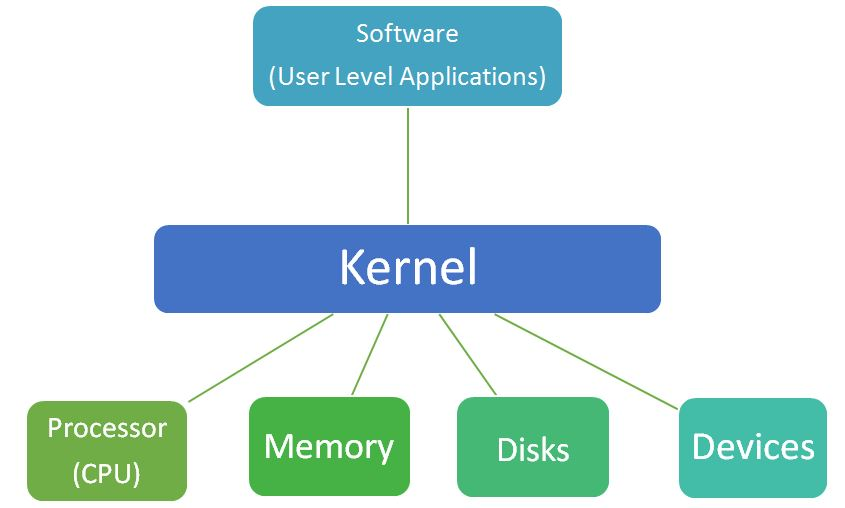
So why is this an issue? HFT is driven by programs and software, and when a kernel’s main goal is to make that software run properly along with other programs in the background, it can take time for important market data to reach the HFT algorithms. There is a lot to handle in the process due to several factors. Typically, the actual delay is just a few microseconds, but again, this is HFT we’re talking about; any latency is a big no-no.
How do HFT firms handle this, then? Simply put, they don’t put up with whatever delays the kernel brings out, so they simply bypass the kernel, the core part of the entire operating system. This is what saves them a lot of time; there is now no need for HFT programs to slowly wait for the market data to arrive through a lengthy process inside the kernel; the path is a lot more direct.
Of course, with no built-in kernel involved to automate the data-to-algorithm process, human engineers will have to manually program how the market data moves through the network and into the algorithms with little to no delays. The skill required for that part is very nasty, often requiring proficiency in multiple programming frameworks, libraries, and an exceptional understanding of how a computer works with all the hardware and abstract architecture.
(…)
Ok, so to sum all that yap above, your daily dose of internet on the MakeCode Forums is that every single second you breathe in the atmosphere, a meticulously designed machine is generating somewhere around $10,000 in assets or perhaps even greater within that small interval. Just some food for thought; I forgot what other purpose there was for this, and I sort of ran out of ideas on how to end this essay.
THE END
10 Likes

i mean
1 Like
far from it pal, many hate that racist team and fans! got harassed during one of the matches by their fans
2 Likes
why not :󠇪(
1 Like
Imagine living near the east coast RAHH West coast forever
Argentina cheated in 2022 I don’t wanna hear it
1 Like
You didn’t call it dvd screensaver
Everyone: “shame shame shame shame”
2 Likes
I am not a car Lil bro, im faster than a car
2 Likes
who is the green guy??
1 Like
April really
I was gonna do it so that we wouldn’t have overlap sheesh sorry I wanted to try this out
3 Likes
sorry about the i have been not soo active i have been desining a DUPLO smart brick that you can code kinda like a micro:bitI may add a arcade mode
1 Like
Nope no inspiration from fnaf either
dr. doom
Oh, that makes a lot more sense. I initially thought you were ridiculing the content of that Google Search essay or something else. So that’s an mb on my part for reacting so harshly. Anyways… If you’re concerned about overlap, then you shouldn’t worry too much; you can go straight ahead. I don’t think that the next essay I write (plan on doing YouTube if that counts) is even going to be abt computer sorting.
4 Likes

I haven’t been affected by them since I just got back to Canada from a long trip today, if you want to know where I went, I went to a lot of countries, that’s all you need to know.
Also what’s happened on the forum in the past… month?
1 Like
cool!!!
2 Likes