huh, guess i’ve been here for a whole year… thats cool`
1 Like
car coster 2 is here : https://makecode.com/_XhtdKperL3UD
Nah it was the first Google result is all.
Did he stand still for the pic? Knowing he’s being watched. 
1 Like
PREFACE
Ladies and Gentlemen. It is time for another essay about a Marvel-Of-Software-Engineering by Dr. Taser. For today’s installment, we will be visiting the game development studio known as Nintendo, which I had already covered in a previous essay about the Wii ( Chatting Area! Have fun! - #8867 by Taser ). Good lord, this is going to turn out as another Google again isin’t it.
AN ESSAY ABOUT THE NINTENDO 3DS
Take a look at the image below you. And yeah, it literally has the name of the console written out for you on the top screen. It is the Nintendo 3DS (yes, I’m trying to be as minimalistic as humanly possible).

As the name “3DS” implies, the Nintendo console has everything to do with 3D space and graphics. Sure, there is some nuance. There are multiple types of 3D graphics in gaming. One is Standard/Monoscopic 3D Graphics, which renders traditional 3D geometry onto the 2D display screen. To experience games like this, all you would need is just a flat screen or a TV set, so there isn’t a lot of fuss involved alongside the price tags. Today, you’ll find that most 3D games you play fall into this category. Some of the most famous/influential video games of all time utilize this type of thing (e.g., Super Mario 64).
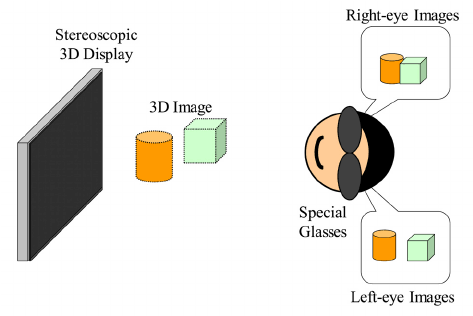
(How Stereoscopic 3D worked before the Nintendo 3DS came out)
Now the other type of 3D Graphics is known as Stereoscopic 3D. These effects aim to give someone much better physical depth through a flat display screen. The way this is achieved is how our actual human eyes perceive physical depth in real life. Two separate and slightly different images are taken. One image is sent for the left eye to view, the other image for the right eye. The brain then merges these two views together, which creates the illusion of 3D space. Now, the flaw with this concept’s execution was that it required additional equipment for the users to wear, such as special glasses. This was very easily interpreted as inconvenient.
Now, Nintendo realized this issue with how Stereoscopic 3D was implemented. Nintendo has had some experience with Stereoscopic 3D graphics in the past, going as far back as to the 1980s, but a lot of that experience did not turn out the way that Nintendo wanted. For example, in 1995, Nintendo released a headset called the Virtual Boy which brought in Stereoscopic 3D graphics. However, the red and black backgrounds resulted in physical discomfort (e.g., headaches) for users, and all production stopped less than 1 year later.

(Virtual Boy color scheme)
In 2004, Nintendo released their handheld console DS which was a massive success. So, they needed to quickly create a sequel console to surpass that boom, they also wanted to return to the old problem that they had been trying to handle (but failed) for decades, which was Stereoscopic 3D graphics. So, to kill two birds with one stone, the Nintendo 3DS was born and it was officially released in 2011.
But when the 3DS was released, a lot of people quickly realized something special that the console had. It had successfully implemented 3D Stereoscopic graphics without needing any other hardware; all one needed was the handheld console. This is otherwise known as Autostereoscopic 3D graphics. That very console solved the inconvenience issue that had been haunting the video game sector of 3D Stereoscopic graphics for a very long time.
How did 3DS achieve this Autostereoscopic effect? See, the 3DS has a total of 2 screens, one at the bottom, and one at the top. Nintendo utilized an old special technology called a Parallax Barrier attached onto the top screen of the console. The barrier is filled with a bunch of vertically-sliced slits/openings. The light (from the top screen) that manages to get through the barrier through the slits is then sent to your left and right eye, forming the two images that will merge together to create the physical depth that Stereoscopic 3D is known for.

The Autostereoscopic effect only works depending on the positioning and angle with how one holds the console away from their faces. If you hold the 3DS a little too close or too far from your face, then the 3D effect kind of gets warped. This issue got patched a bit when Nintendo later added face/eye-tracking in their console, so the 3D effect remains a lot more consistent regardless of angular positioning. Also regarding the bottom screen of the handheld console, it is mainly used as a touchpad, making it particularly useful for mechanics that involve touchscreen one way or another (e.g., game menus).
The 3DS also introduced a new networking feature that turned out to be quite popular. Let’s say that you shove your (sleep mode) 3DS handheld directly in your pocket and you go for a walk on the street. On that same street, there is another person who has a 3DS in their pocket. When you two move past each other, your built-in-to-the-console Mii characters will essentially interact with one another, sharing data with one another (e.g., favorite games). This feature was known as Streetpass, and it essentially works in which whenever you turn your 3DS console asleep, it will begin searching for other 3DS consoles near them via radio signals.
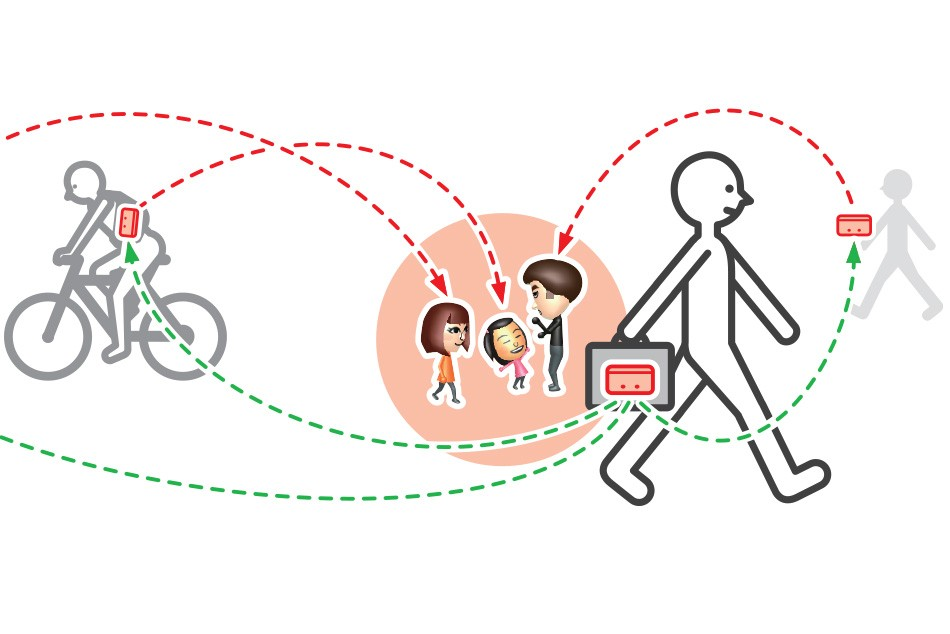
(Streetpass in action)
Another “Pass” that Nintendo implemented into their console was Spotpass. While in sleep mode, the 3DS console will connect itself to nearby internet routers and other points to gain access to WiFi. This allowed the 3DS to automatically download new content and data (e.g., game updates) themselves while the screen is turned off.
The Nintendo 3DS is also famous for having a massive homebrew community. People were able to find loopholes and bypass a bunch of Nintendo’s security measures in their kernels to gain administrative access that is typically blocked off to most people. This allowed for many people to easily mod the console to their liking. A good majority of these mods come down to User-Interface-customization, managing saved data on the console’s games, or bringing in other games from older consoles (e.g., NES) into the menu.
(…)
For the previous Nintendo essay that I posted regarding the revolutionary console Wii, I mentioned how the Wii had some generational cultural impact on the global scale. Unfortunately, it’s difficult to make the same argument for the 3DS. While the 3DS did sell well with over 75,000,000 units sold by the end of its production in 2020, it never did reach the same heights of Nintendo’s DS or the Wii. A good reason for this is likely the hefty $250 price tag that it came with on release, along with some flawed marketing on Nintendo’s part.
On a software and hardware level, the Nintendo 3DS is definitely an underrated console considering how it was the middle child in between the commercially and technically impressive behemoths that were the Nintendo Wii, DS, and the Switch (which would release later in 2017). But, for Nintendo, it was quite the special one. For over 30 years, the company had tried to implement 3D Stereoscopic graphics in their games and consoles but failed miserably in execution. But the 3DS proved to be a successful one; it had been their first ever commercially-successful console that had 3D Stereoscopic graphics without requiring any special equipment. Such a product putting an end to a decades-long journey, I think most engineers would be proud to have participated in that conclusion.
THE END
10 Likes
I got SpriteStars mixed up with CodeStars 
6 Likes