No.
Neither. I volunteer my time, and the engineers are paid as … engineers, not moderators.
No.
Neither. I volunteer my time, and the engineers are paid as … engineers, not moderators.
some badges have titles enabled although they are getting rarer by the day with the Mini Game Jam and Game Jam Participant titles getting disabled
from looking at your badges you currently have no badges for titles, so you have to win a game jam or do something like woof woof did to get attention from the mods
ahh I see…
ok thanks
it’s a side scroller that you battle slime guys in 2090
welp I was close
Alright, I really don’t have much to say for the preface this time around. All I can say is that the essay below is not related to the other poll that I posted above in the chatting area ( Chatting Area! Have fun! - #8629 by Taser ). This essay will focus more on a specific aspect in theoretical Computer Science, rather than applied programming marvels.
____________________________________________________________________________
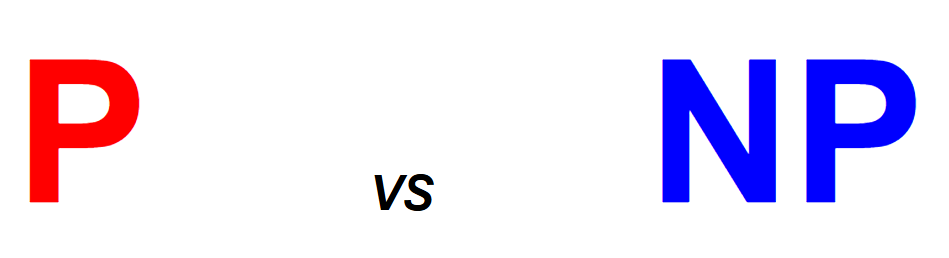
Take a look at the image below. It is a very simple image indeed, but it pretty much represents the prompt of the most important problem to ever exist in the field of Computer Science. A problem in which the solution has never been found, but also a problem that could change everything. That is… Does P equal NP?
The first question about this very problem is probably what P and NP actually mean, so let’s start slow. P stands for Polynomial Time. To put it simply, P is a case in which you have a problem that can be very easily solved from scratch by a computer while remaining highly efficient.
For example, let’s say you have a list made up of hundreds of names, and you want to search for one specific name out of those hundreds. You can easily implement a search algorithm (e.g., binary search after sorting the list) to find that one specific name, and you should receive the correct output within less than 1 second. The result remains the same even if the length of the list increases to thousands or millions.
NP, in the meantime, stands for Nondeterministic Polynomial time. To (again) put it simply, NP is a case in which you already have a potential solution right in front of you, and that solution could easily be verified by the computer. But if you had nothing in front of you and you had to find the answer yourself, things get nasty really quickly.
For example, let’s say that you have a 9 x 9 sudoku grid, and you have already filled it out. You want the computer to check if you correctly solved the Sudoku. The entire process is very simple, easy, and efficient for the computer. All it needs to do is check if your inputs followed the rules of sudoku (no duplicate numbers in a single row, column, or box).
Now let’s reverse it; let’s give the computer the same 9 x 9 sudoku grid, except this time it’s not filled out; the computer has to get the solution on its own. The process takes slightly longer than verifying answers, but the computer should be able to finish the sudoku quickly.
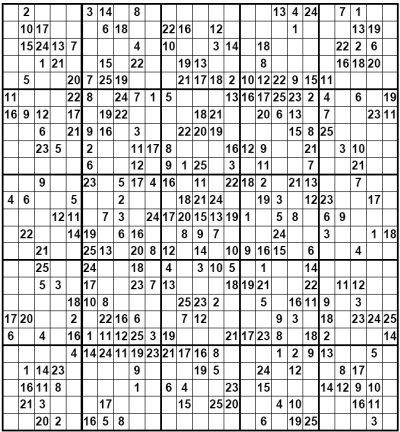
(25 x 25 Sudoku Grid)
But why limit the dimensions of the grid to only 9 x 9? What if we remove the limit? What if we generalize Sudoku? Now our grids can have dimensions of 16 x 16, 25 x 25, or 100 x 100, and it only gets larger down the road. As the grid size increases, the difficulty for the computer to solve the Sudoku increases as well, at an exponential rate. Eventually, it reaches a point at which not even the most powerful supercomputers can solve the new sudoku grids without already having the solution to begin with. If the computers had the solution, no matter the grid size, it would be easy to verify.
With those definitions of the P and the NP in mind, the hard problem of whether P equals NP boils down to:
In any problem, if the solution is easy to verify, is it just as easy to get the solution from scratch?
Many scientists strongly believe that P does not equal NP, in which it is far more difficult to find a solution compared to verifying a solution already given to them; most find the idea of P = NP to be too good to be true (to be explained why later). But, at the current moment, what they are saying is pure conjecture. There currently exists no rigorous proof out there that supports either P = NP or P != NP. Without a verified proof, there cannot be absolute certainty. There have been many attempts by brilliant scientists and mathematicians in the past, but the problem still remains unsolved.
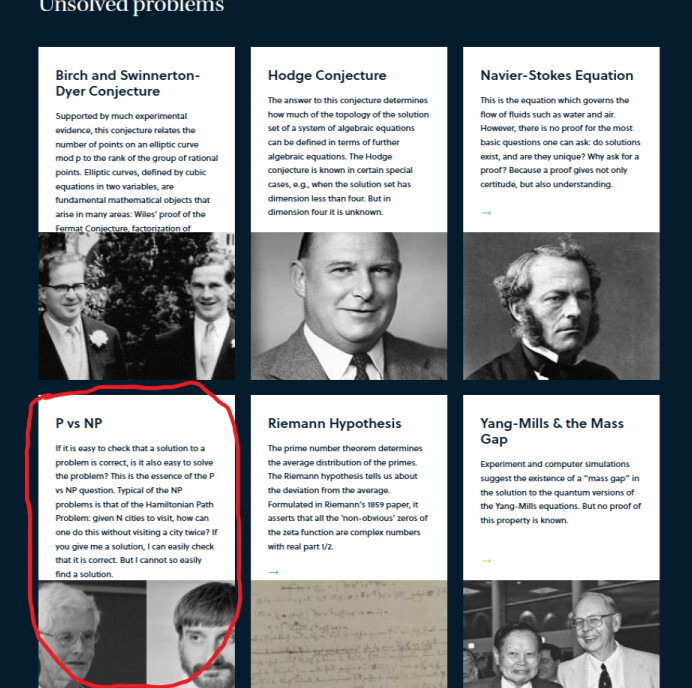
(The Millennium Prize Problems, proofs are worth $1,000,000 if verified)
There is a good reason why a verified proof of the P vs NP problem is worth $1,000,000 as a Millennium Prize Problem. A proof that shows that P = NP would be highly revolutionary. If we know for sure that P equals NP, then humanity could accelerate the medical field by a large margin (find a cure for the incurable + terminal diseases). We could find the perfect path for shipping (trivializing all the optimization problems in logistics). It could probably result in the solution proofs for the other $1,000,000 Millennium Prize Problems, which would be extremely big for the fields of mathematics + physics.
But the core idea of “if a problem had a solution that could be easily verified, it could be easily solved from scratch” can also pose potential dangers to humanity. One big case would be modern cryptography, which is what we use to protect our personal data (PII) when we interact on the internet. Now all the encrypted data can easily be decrypted by the malicious for fresh exploitation purposes; most modern cryptography could shatter overnight.
All of this can either sound highly exciting or terrifying for one to witness. But one thing is for certain: as long as the P vs NP problem remains unsolved with no verified proof existing, we will not be able to see such a revolution occur, if there will be one, since P might not be equal to NP at the same time. Until then, unless there are actually theoretical computer scientists on these forums, all we can do is wait for the proof to come along and potentially change the world.
i turned blocky boss battle into this: https://arcade.makecode.com/S03538-72744-92782-73987
(Thats alot of impressive stats… would any villain even stand a chance?)
Actually, do you have a story planned with Reyce?
i’m back! was taking a few days off of computers
yes but im too lazy to do anything with it for now
hmmmmm… I’ll work on it soon! 
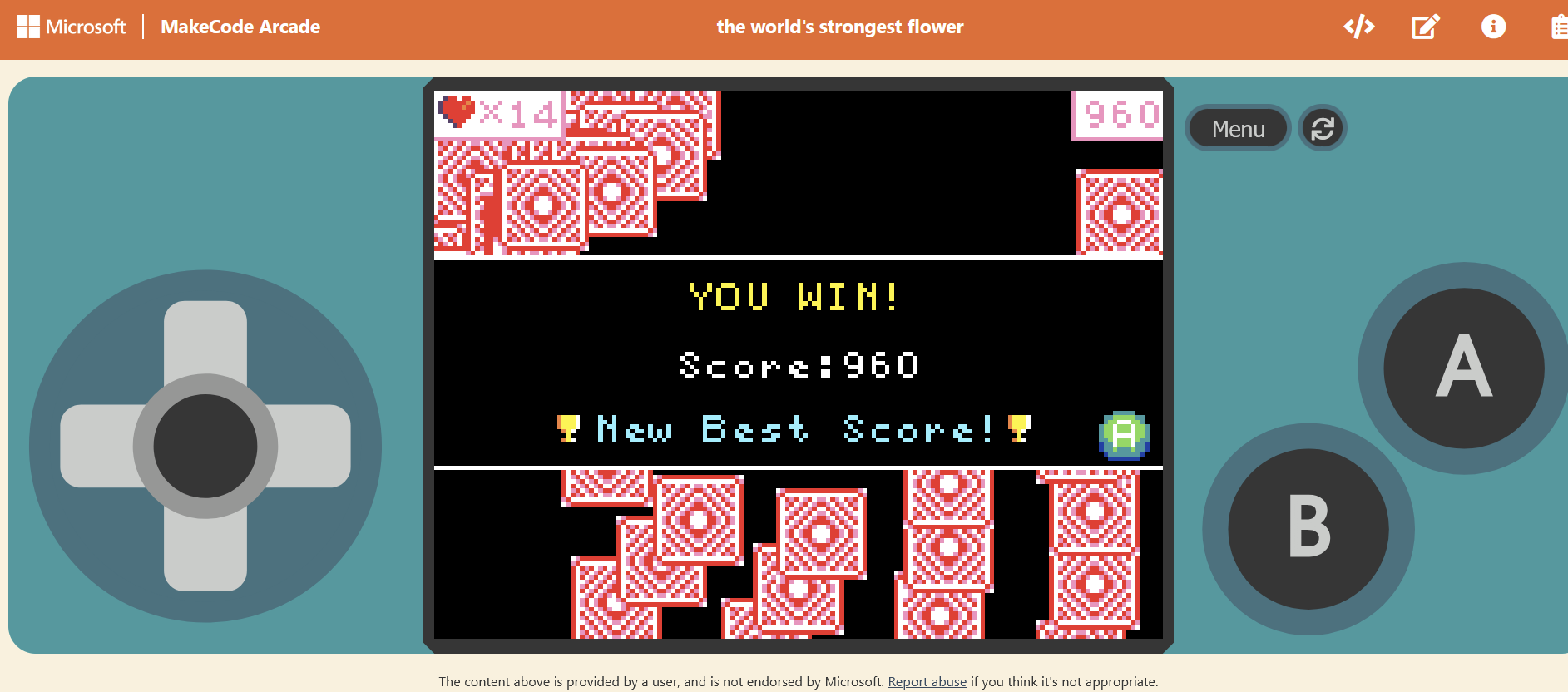
dang. the best i can do is 75 hearts. also thats some FAST clicking! its still on stage 2 and the remaining bullets are connected 
dude im not even kidding i tried to beat this like 11 times. My spacebar started getting warm and then my fingers went raw sooo u win 
This essay is very long and I will read it later, but
This is what your line looks like on mobile. If you type three dashes you can get a better one
which also accounts for screen size.
There is probably an html code for this but I can’t be bothered.
Just wanted to help your posts look better, keep up the great work!
aaaah, here it is, the second version. https://arcade.makecode.com/S41911-01046-61187-53742
How the heck do you guys win that???