ahh I see…
ok thanks
ahh I see…
ok thanks
it’s a side scroller that you battle slime guys in 2090
welp I was close
Alright, I really don’t have much to say for the preface this time around. All I can say is that the essay below is not related to the other poll that I posted above in the chatting area ( Chatting Area! Have fun! - #8629 by Taser ). This essay will focus more on a specific aspect in theoretical Computer Science, rather than applied programming marvels.
____________________________________________________________________________
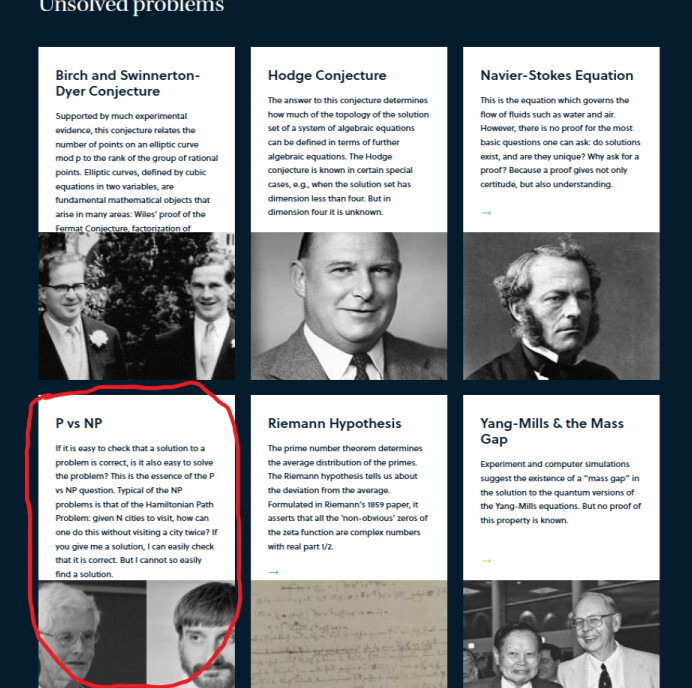
Take a look at the image below. It is a very simple image indeed, but it pretty much represents the prompt of the most important problem to ever exist in the field of Computer Science. A problem in which the solution has never been found, but also a problem that could change everything. That is… Does P equal NP?
The first question about this very problem is probably what P and NP actually mean, so let’s start slow. P stands for Polynomial Time. To put it simply, P is a case in which you have a problem that can be very easily solved from scratch by a computer while remaining highly efficient.
For example, let’s say you have a list made up of hundreds of names, and you want to search for one specific name out of those hundreds. You can easily implement a search algorithm (e.g., binary search after sorting the list) to find that one specific name, and you should receive the correct output within less than 1 second. The result remains the same even if the length of the list increases to thousands or millions.
NP, in the meantime, stands for Nondeterministic Polynomial time. To (again) put it simply, NP is a case in which you already have a potential solution right in front of you, and that solution could easily be verified by the computer. But if you had nothing in front of you and you had to find the answer yourself, things get nasty really quickly.
For example, let’s say that you have a 9 x 9 sudoku grid, and you have already filled it out. You want the computer to check if you correctly solved the Sudoku. The entire process is very simple, easy, and efficient for the computer. All it needs to do is check if your inputs followed the rules of sudoku (no duplicate numbers in a single row, column, or box).
Now let’s reverse it; let’s give the computer the same 9 x 9 sudoku grid, except this time it’s not filled out; the computer has to get the solution on its own. The process takes slightly longer than verifying answers, but the computer should be able to finish the sudoku quickly.
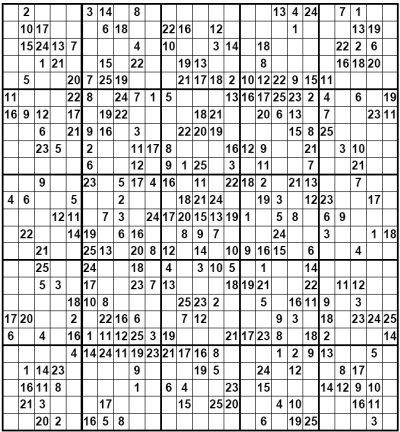
(25 x 25 Sudoku Grid)
But why limit the dimensions of the grid to only 9 x 9? What if we remove the limit? What if we generalize Sudoku? Now our grids can have dimensions of 16 x 16, 25 x 25, or 100 x 100, and it only gets larger down the road. As the grid size increases, the difficulty for the computer to solve the Sudoku increases as well, at an exponential rate. Eventually, it reaches a point at which not even the most powerful supercomputers can solve the new sudoku grids without already having the solution to begin with. If the computers had the solution, no matter the grid size, it would be easy to verify.
With those definitions of the P and the NP in mind, the hard problem of whether P equals NP boils down to:
In any problem, if the solution is easy to verify, is it just as easy to get the solution from scratch?
Many scientists strongly believe that P does not equal NP, in which it is far more difficult to find a solution compared to verifying a solution already given to them; most find the idea of P = NP to be too good to be true (to be explained why later). But, at the current moment, what they are saying is pure conjecture. There currently exists no rigorous proof out there that supports either P = NP or P != NP. Without a verified proof, there cannot be absolute certainty. There have been many attempts by brilliant scientists and mathematicians in the past, but the problem still remains unsolved.
(The Millennium Prize Problems, proofs are worth $1,000,000 if verified)
There is a good reason why a verified proof of the P vs NP problem is worth $1,000,000 as a Millennium Prize Problem. A proof that shows that P = NP would be highly revolutionary. If we know for sure that P equals NP, then humanity could accelerate the medical field by a large margin (find a cure for the incurable + terminal diseases). We could find the perfect path for shipping (trivializing all the optimization problems in logistics). It could probably result in the solution proofs for the other $1,000,000 Millennium Prize Problems, which would be extremely big for the fields of mathematics + physics.
But the core idea of “if a problem had a solution that could be easily verified, it could be easily solved from scratch” can also pose potential dangers to humanity. One big case would be modern cryptography, which is what we use to protect our personal data (PII) when we interact on the internet. Now all the encrypted data can easily be decrypted by the malicious for fresh exploitation purposes; most modern cryptography could shatter overnight.
All of this can either sound highly exciting or terrifying for one to witness. But one thing is for certain: as long as the P vs NP problem remains unsolved with no verified proof existing, we will not be able to see such a revolution occur, if there will be one, since P might not be equal to NP at the same time. Until then, unless there are actually theoretical computer scientists on these forums, all we can do is wait for the proof to come along and potentially change the world.
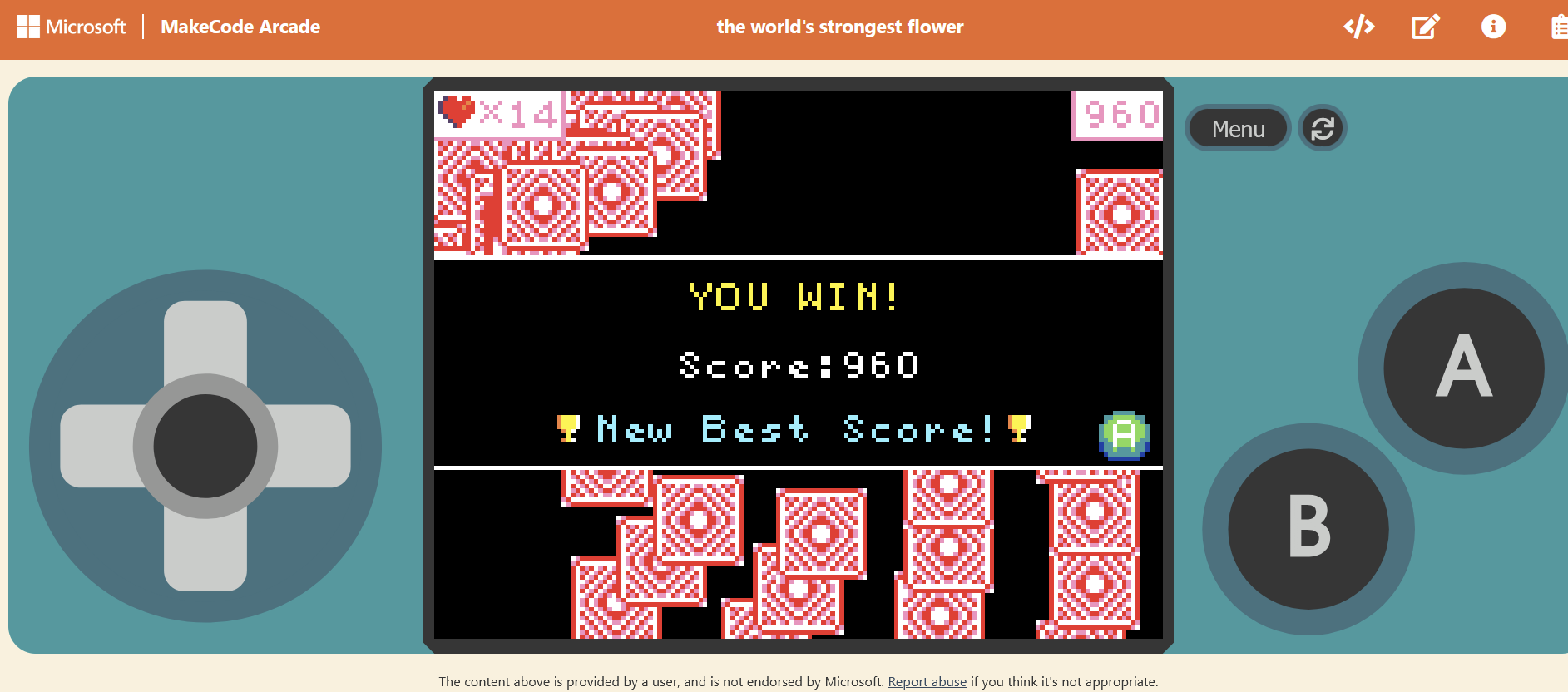
i turned blocky boss battle into this: https://arcade.makecode.com/S03538-72744-92782-73987
(Thats alot of impressive stats… would any villain even stand a chance?)
Actually, do you have a story planned with Reyce?
i’m back! was taking a few days off of computers
yes but im too lazy to do anything with it for now
hmmmmm… I’ll work on it soon! 
dang. the best i can do is 75 hearts. also thats some FAST clicking! its still on stage 2 and the remaining bullets are connected 
dude im not even kidding i tried to beat this like 11 times. My spacebar started getting warm and then my fingers went raw sooo u win 
This essay is very long and I will read it later, but
This is what your line looks like on mobile. If you type three dashes you can get a better one
which also accounts for screen size.
There is probably an html code for this but I can’t be bothered.
Just wanted to help your posts look better, keep up the great work!
aaaah, here it is, the second version. https://arcade.makecode.com/S41911-01046-61187-53742
How the heck do you guys win that???
It is currently 07/12/2026 as I am typing out the preface. So, like 1 week ago, I posted a poll where I suggested the idea ( Chatting Area! Have fun! - #8629 by Taser ) that I could write monthly essays that essentially yaps about a specific marvel of software engineering. It seems like quite a bit of the MakeCoders on the forums liked the idea, so here we are. I kind of forgot what else to say for the intro here, so let’s just get a move on.
If you wanted to find any information on the vast World Wide Web, there are a variety of search engines and tools that you can pull out of your brain, like Bing or Yahoo. But what is the first search engine that will likely always pop up in your head? It is Google. It’s for good reason as well, with the corporation holding control of over 90% of the worldwide search market.
It’s worth noting that Google’s search engine was not the first search engine to ever exist, just like how Apple’s iPhone was not the first smartphone to ever exist. They were just new products in an already-existing field that revolutionized it, and they had made massive profits + success as a result of that.
Prior to Google, most internet search engines used a “keyword matching” algorithm; websites were put in order based on the number of times the keyword (the stuff you typed in the search bar) showed up on the webpage. If you tried to search for “pears”, the website that appeared at the top was the one that had the most cases of “pears” showing up in text.
Unfortunately, this is all considered flawed methodology. With the only basis (for which website is given the spotlight) being from a counter of keyword appearances, there were some inevitably bad results. People knew about keyword matching algorithms and could manipulate them in their favor. If you wanted to search for “Apple” as in the tech company, there was the risk that the website at the top did not belong to the official corporation but to a malicious copycat website. Needless to say, Google Search was developed to address these suboptimal ways of past internet search engines.
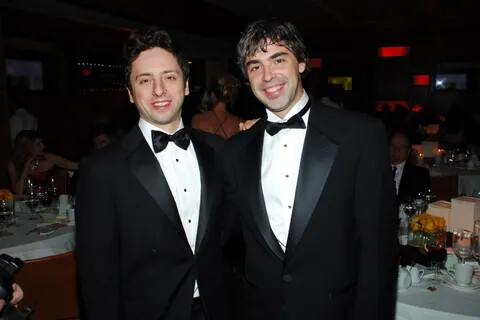
(Larry Page and Sergey Brin)
But let us first get some context regarding the 2 minds who started it all. Larry Page and Sergey Brin. These 2 met when they were students at Stanford doing a PhD in Computer Science during the year 1995, with Sergey Brin having been in grad school before Page came along. One night, Page had a dream where he supposedly downloaded the entire World Wide Web and kept only the web application links; that one dream became the basis of Google’s algorithm really quickly.
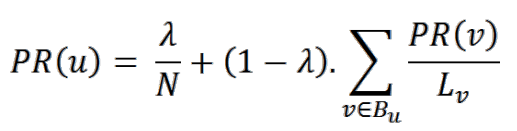
After that night, Larry Page and Sergey Brin quickly got to work on creating the mathematical algorithm based on what Page had dreamed about; the algorithm was called PageRank (named after Larry Page). As the “rank” part of the name implies, the algorithm involved not “keyword matching” but scoring and ranking webpages by quality/importance, already setting it above past search engines on the internet.
In PageRank, the basis for scoring webpage quality was based on the hyperlinks that sites contained. Hyperlinks would be seen as high value, like research paper citations. Not all hyperlinks are made equal; a link to a highly credible webpage (e.g., Harvard University) is given more weight in the mathematical algorithm compared to an unknown opinion-based blog website. The algorithm also made the safe assumption that there was an 85% chance that a web surfer would randomly click on links without getting bored; this was known as the damping factor.
The PageRank algorithm was used for the larger search engine project known as Backrub. In 1997, though, the 2 founders realized that Backrub was a horrible name, and it was renamed to the name we all know today: Google. The new domain name was initially meant to be “Googol,” as in referring to the massive number (10^100). But then a typo happened, resulting in “Google,” and the name stuck after that.
Google continues to utilize the PageRank algorithm in its search engine to this day, where webpage quality is based on contained hyperlinks. However, over the years, the full algorithm has changed quite a bit; PageRank’s formula is now one piece of the puzzle rather than being the sole backbone of the entire engine, with a lot more utilization in AI/ML applications to get more accurate search results.
(↑ One particular well-known AI application that Google uses in its search engine is known as BERT, which takes into account all the words in the user’s query with the surrounding context, rather than just individually analyzing every last word like in the past. This allows for more nuance and potentially more relevant results. This is also considered an application of Natural Language Processing (NLP) and transformers)
Today, Google uses a three-step process that makes the entire search engine work the way it is. The first step involves having web crawlers scour through the World Wide Web in search of billions of accessible webpages; a lot of these webpages are discovered through hyperlinks in other applications, and other webpages have already been discovered. These crawlers are known as Googlebots, and they come in large numbers through a lot of powerful computers.
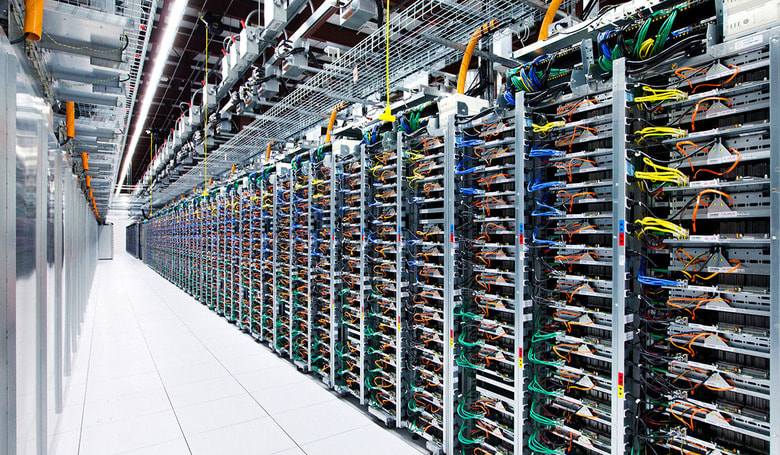
(Google’s Servers)
After a website has been crawled through by a Googlebot, it is time for step 2: indexing. An in-depth analysis is done on the webpage and all the data that it contains (e.g., text, images) through powerful algorithms. This is to determine just what the webpage contains, along with potential quality/credibility. The data found is then put into a database called Google Index.
Also, note that Google has its Googlebots crawl through billions of webpages, so no doubt that the Index is going to have to run on thousands of servers simultaneously. In fact, the Google index has a size exceeding 100,000,000 gigabytes, which is hard to imagine the scale of. You could stuff a lot of distinct, common, or rare items across all of human history, and there is a good chance that there will still be a very large chunk of leftover space.
The 3rd and final step (serving/ranking) comes in when the user actually searches for something. The algorithm goes through the Google Index to find relevant webpages/websites to bring out. All these pages are then ranked in order based on their overall quality/credibility, which is calculated based on a variety of factors, such as content, your location, and load speed. The ranking is done through hundreds of complex ranking systems (including PageRank). The number of websites to rank is in the billions. And your search results are shown in less than 1 second, isn’t that just amazing?
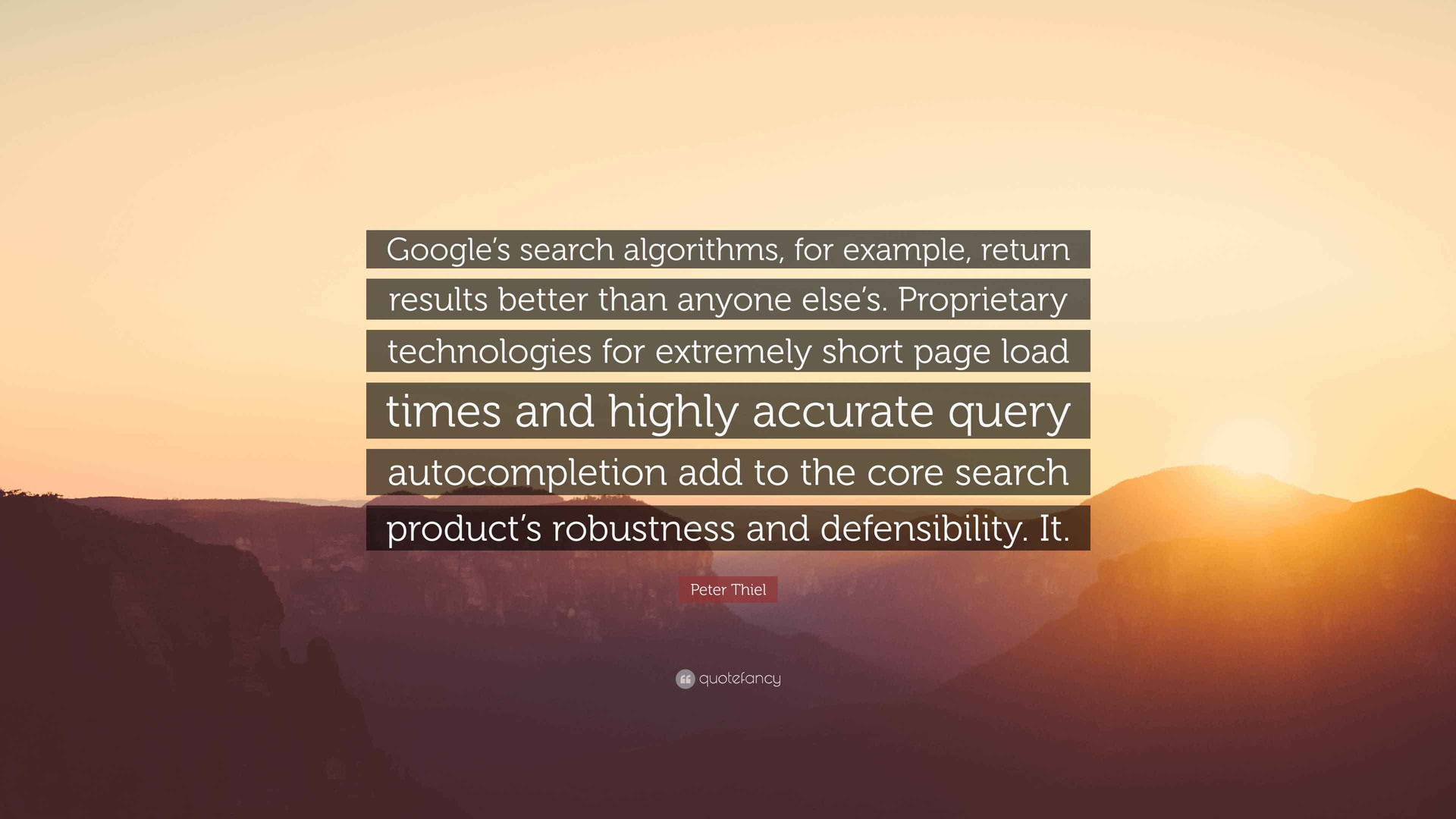
As mentioned at the very start, Google Search is without a doubt the most popular search engine out there. There is a reason why over half of FAANG or Big Tech never attempted to create a competitor against the behemoth that is the Google Search algorithm. Now, as for how Google got its reputation for that instance. Tech billionaire Peter Thiel says it best:
(Peter Thiel Quote)
Who knows? Maybe one day, after many years, a new or already-existing tech company will come in with a much better search engine than what Google already has. Or Google leaks its entire codebase that powers its search engine. But when you focus on the present and look at the current state of affairs, you’ll find that Google will remain a highly influential ruler of the entire internet for a very long time.
made a song for the goober himself took a hour so I hope he likes it!