PREFACE
Good Morning (as I am currently typing out this preface). This marks the 12th essay that I posted for this Summer and probably the last one I’ll do for a while.
For this essay, I will be covering a very important person in theoretical Computer Science. An intellectual genius who was truly ahead of his time and set the standards for our devices and software today. A Computer Scientist who was prosecuted for horrible reasons, but whose work would send ripple waves through the world even over 70 years later.
With this, I am officially done with all the essays for Summer 2026. It’ll be a while before I post any more yap on the forums, so please enjoy, and thank you!
ALL SUMMER 2026 ESSAYS
P VS NP Problem: Chatting Area! Have fun! - #8657 by Taser
Google Search: Chatting Area! Have fun! - #8671 by Taser
High-Frequency Trading: Chatting Area! Have fun! - #8798 by Taser
YouTube: Chatting Area! Have fun! - #8851 by Taser
Nintendo Wii: Chatting Area! Have fun! - #8867 by Taser
Discord: Chatting Area! Have fun! - #8922 by Taser
Google Maps: Chatting Area! Have fun! - #8959 by Taser
1993 DOOM: Chatting Area! Have fun! - #9045 by Taser
Nintendo 3DS: Chatting Area! Have fun! - #9101 by Taser
Amazon Web Services: Chatting Area! Have fun! - #9177 by Taser
Programming Language C: Chatting Area! Have fun! - #9283 by Taser
(and This Essay)
AN ESSAY ABOUT ALAN TURING
Today, we use computers in many aspects of our lives. Schools distribute laptops to their students to do their schoolwork (lots of assignments are online). Workers now use computer software and hardware to do their jobs. There are a variety of computers used today, like Chromebooks, Macs, and Dell computers. But behind all the computers that we use today, they were strongly inspired by the works of one man. That man is considered the “Father of Computer Science.” That man was known as Alan Turing.
Turing was born on 06/23/1912 as the son of a civil servant in London, England. He attended a prestigious boarding school called Sherborne Boys in Dorset. Turing showed a very strong knack for mathematics and sciences at a young age. At only the age of 16, he was capable of understanding Einstein’s papers and equations. Unfortunately, Sherborne did not exactly appreciate Turing’s large focus on science; the school’s curriculum focused a lot more on humanities and classics.
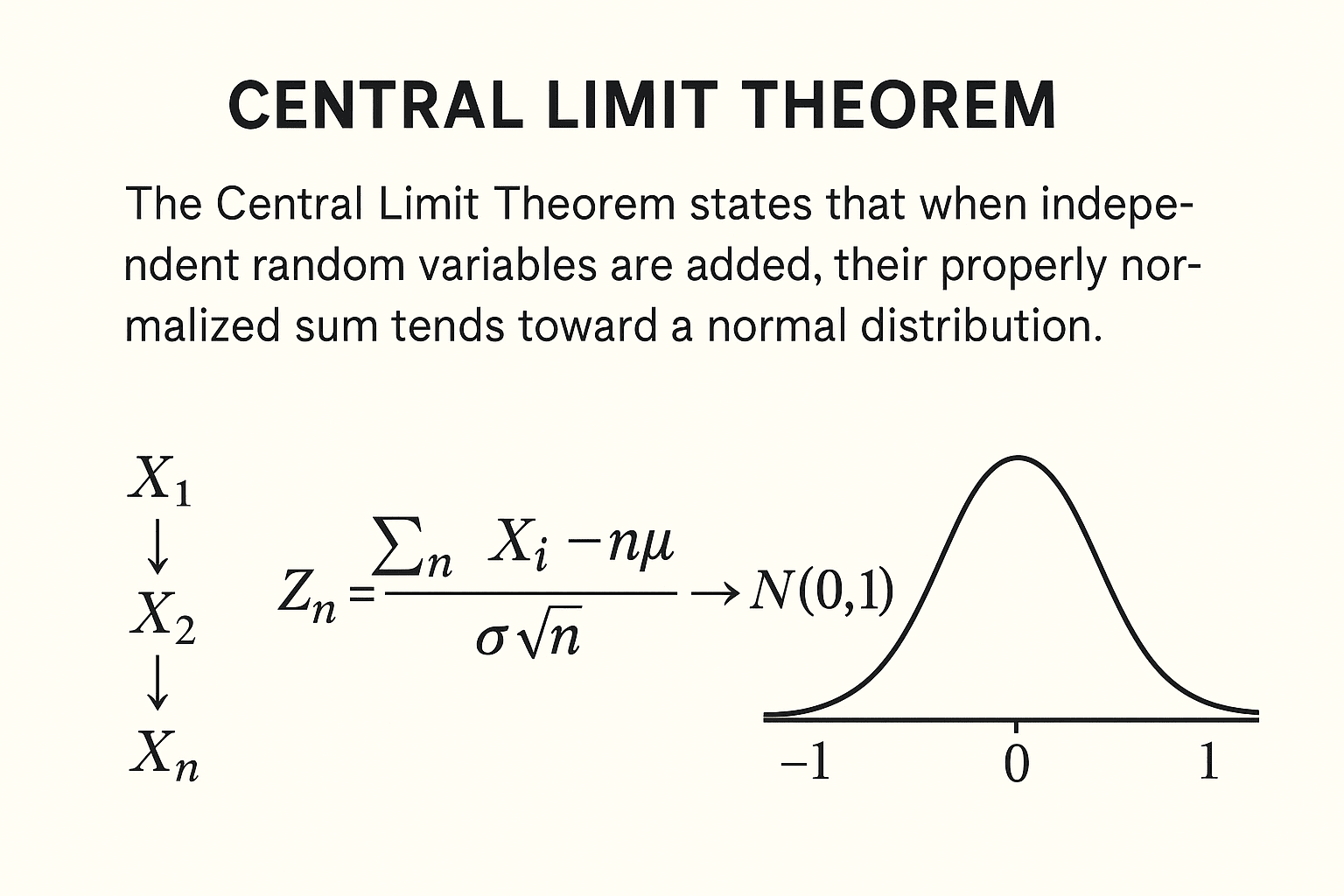
He entered King’s College in 1931 to study mathematics, which is considered part of the University of Cambridge (one of the top universities in the world). During his time at university, he spent quite a good chunk of time conducting research on probability theory. In his senior year, he would publish a mathematical proof dissertation called “On the Gaussian Error Function” in which he proved the Central Limit Theorem. Now, this theorem was technically discovered and proven by expert mathematicians decades prior, but Turing had no idea of its existence when writing the proof.
Turing graduated in 1934 with a degree in Mathematics from King’s College. The people at the University of Cambridge were so impressed by Turing’s dissertation that they awarded him a fellowship in 1935. Simply achieving that would be an incredible feat for someone in their early twenties. However, not long after graduation, Turing would publish a paper/proof called “On Computable Numbers, with an Application to the Entscheidungsproblem” that would revolutionize Computer Science forever and the devices we all use today.
In 1928, mathematicians David Hilbert and Wilhelm Ackermann set forward a problem called the Entscheidungsproblem (otherwise translated to Decision Problem). The problem basically just asked if there exists a program/proof that could take in any statement and output whether that statement is True or False. Turing came across this problem in 1935 after attending a lecture at the University of Cambridge (Professor Max Newman). Months later, in 1936, Turing would publish a proof (On Computable Numbers, with an Application to the Entscheidungsproblem) that proved the Entscheidungsproblem to be impossible; there would be one part of the proof to hog the spotlight. It was the Turing Machine.
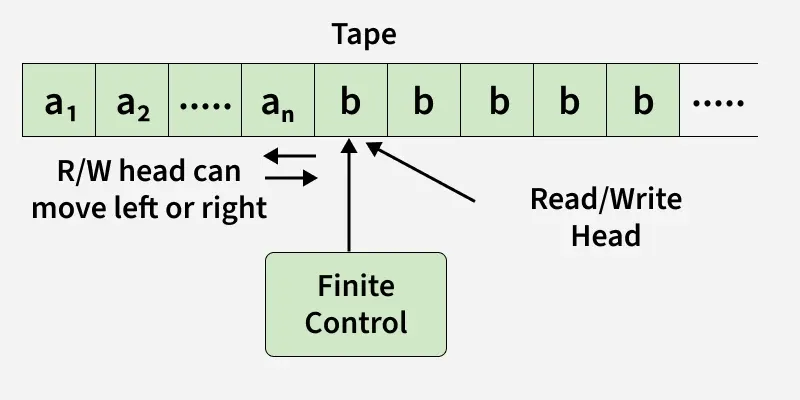
Now, the Turing Machine is not a physical computer; rather, it is more of a theoretical model. The Turing Machine consists of an infinitely-long roll of tape. Many squares are drawn onto the tape, meant to represent distinct sections/portions of the neverending roll. These squares also contain a symbol, which could either be a “0”, “1”, or nothing at all. There is also a read/write head attached to the tape; it traverses across the squares on the tape. When it gets on a square, it can either read the symbol on it, write a new symbol on the square, or move to the left/right. The machine comes with a set of instructions for the read/write head. The machine also stores the current state of the tape to determine its next move.
(Turing Machine visualization)
So, what makes the infinite roll of tape so influential? If we’re comparing the Turing Machine with modern computers, it would appear that the tape acts exactly like a computer’s RAM; it has infinite storage. With that much possible computational power, you would think that the Turing Machine could solve most problems out there, regardless of their complexity. But there do exist problems that the Turing Machine cannot solve (making the Entscheidungsproblem impossible). If that’s the case, then it means a modern computer with finite RAM likely cannot solve that problem as well. This properly sets a limit as to what a computer is simply unable to do.
There is something more to the Turing Machine: it set up a universal standard with which most computer systems and programs adhere today, a standard called Turing-Complete. If a computer or software could replicate all the actions of a Turing Machine, capable of running any program or calculation if given enough memory, then it would be Turing-Complete. Many tech companies are aware of this system. For example, every piece of hardware that Apple released (e.g., iPhone, MacBooks) is considered Turing Complete.
If it wasn’t made obvious already, Turing was truly ahead of his time when it came to Computer Science. Let me give you another example. In this current era we live in, a new technological advancement called Artificial Intelligence (AI) is rising into mainstream status. A lot of these AI applications are chatbots that have been fed data across the internet. This “feed me data for better results” phenomenon is otherwise known as Machine Learning (ML). However, all the stuff regarding AI/ML didn’t just start off in the 21st century; the foundations were laid over 70 years ago by Turing.
In 1948, Turing would write a paper called “Intelligent Machinery.” It merely suggested that perhaps Machines could make human thoughts and think like the human brain could if it was rigorously trained. This is also how a human child can develop intelligence, through rigorous training. Wouldn’t you know it, this also seems very similar to how AI models are trained today (Machine Learning). So this paper clearly has an impact on our technological advancements even after 70+ years have passed.
(Visual of Turing Test. In this case, A is the Machine, B is the human speaker, and C is the human judge who has to distinguish A from B)
Turing would go further with this idea of AI. In 1950, Turing would publish a paper called “Computing Machinery and Intelligence” which posed a question: “Can machines think?” That paper would become revolutionary for an idea that it posed called The Imitation Game, or otherwise called The Turing Test. The test is very simple: you have a human judge who first converses with a machine in text, then converses with an actual human in text. The human judge does not see any faces when conducting the conversation. If the human judge is unable to distinguish the human speaker from the machine, then the machine passes the Turing Test.
The Turing Test would set a baseline for intelligence. For the next couple of decades after 1950, AI research scientists and engineers would attempt to develop a model that could pass the Turing Test. A lot of them thought that if a model could pass the Turing Test, then it could mean that machines really could think for themselves. Although, today, there is some debate over whether the Turing Test proves true human intelligence or not (maybe it shows deception instead). Many modern AI models have been shown to pass the Turing Test.
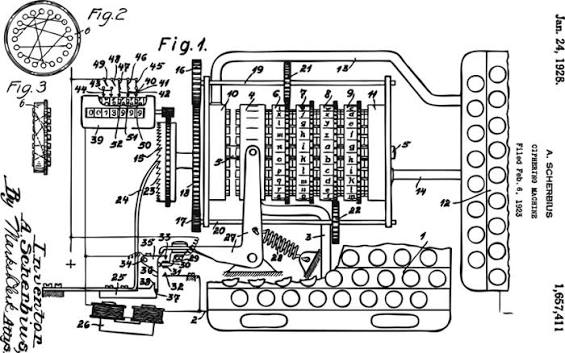
But, never mind Turing Tests or Turing Complete. Perhaps Turing’s greatest achievement was made in WW2. During the wartime effort, Germany was using complex ciphers to communicate battle plans/strategies to German officials; the most famous cipher that they used was Enigma. Enigma was an electromagnetic device that scrambled each letter of a message using several distinct rotors that moved in a very specific pattern. A coherent word can easily turn into a bunch of gibberish. Every day, German operators, who appeared to have made universal decryption algorithm impossible, would update that specific rotor pattern.
(Diagram of the Enigma Machine)
Turing was working in the UK Intelligence Agency at Bletchley Park during the war. The team was focusing on decoding a bunch of naval Enigma-encrypted messages that England had intercepted. The team found a few common yet significant patterns with how the Enigma cipher worked, despite the daily updates, like there being no self-encryption (“H” being encrypted to the exact same letter of “H”). Now, a few years back, the Polish had actually cracked the Enigma code and they handed over all their findings to the British in 1939, with a decryption device called the Bomba.
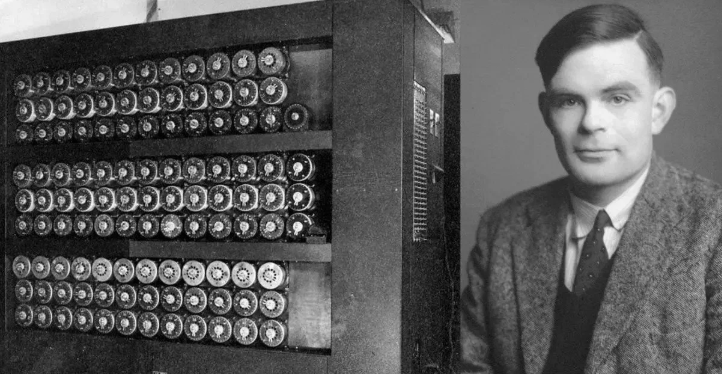
The team at Bletchley Park would take in the Polish Bomba device and improve it further, developing a new machine called the Bombe. As mentioned in the previous paragraph, there were common patterns in the encryption algorithm even after all the updating. This eliminated many combinations of rotor settings and cut down the amount of computations that the decryption machine had to do. The team also found that the Germans would send encrypted messages that included quite predictable phrases (e.g., “Weather Forecasts” being encrypted into “Wetter Vorhesage”); these phrases were called “Cribs.” The team would use these cribs for configuring the Bombe machine and predicting the settings that the German Enigma machine was on.
(The Bombe Machine with a female operator)
The Bombe machine would be extremely beneficial for the Allies in WW2. By being able to decrypt German Enigma military messages, the Allies now got a better picture of what the Germans were planning and their formations. This gave the Allies a much better reference to prepare for future battles against Germany. The majority of historians estimate that the invention of the Bombe machine shortened the length of WW2 by at least 2 years and saved millions of lives in the process. In 1941, England’s prime minister Winston Churchill would personally thank Bletchley Park for their efforts.
Unfortunately, Turing would experience a deep amount of disrespect for all the life-impacting work that he put in. Turing was a homosexual person, and the country he resided in was a very homophobic England. By “homophobic”, simply being gay was considered a felony. In 1952, the police discovered the truth about Turing, and he was arrested and prosecuted. Turing would also lose his security clearance and would never work in UK Intelligence ever again.
(Alan Turing’s Memorial)
On 06/07/1954, Alan Turing died at the age of 41, having been found with a half-eaten poisoned apple near him. It wouldn’t be until 2013 when Turing (who had been dead for 59 years by then) was pardoned by Queen Elizabeth II. However, those 41 years were more than enough for Turing to cement his name as the “Father of Computer Science.” His cryptography work saved millions of lives in the deadliest military conflict in history. He set the benchmark for AI/ML models with his Turing Test, 70 years before it all became mainstream. His theoretical models would become a blueprint for all the computers and software we use today. We might never see another genius in Computer Science achieve this much within 41 years ever again.
THE END