(NOTE: I am only referring to unofficial game jams if you haven’t guessed already)
I find that this date is a very good time to be posting this kind of stuff; As I am typing all of this out, we are in the middle of June right now, so I would suspect that there would be a ton of new unofficial game jams being started. Regardless, this guide and its content should be perfectly applicable for all cases, regardless of which of the 4 seasons we are in.
Now, nearly 3 years ago, I made a previous guide (see link below) revolving around the same premise: “How can a host lead his gamedev competition to success?” This massive post that you are reading rn is essentially a revamped version of that older guide, with me going into more depth, discussing more factors, and some visual aids to engage the audience better.
Dr. taser's guide to making a successful coding competition
(it’s still pretty helpful on its own)
Anyways, that is enough yap for the introduction/prelude. Below are 6 organized sections, each of them discussing an important characteristic that every kind of game jam will be involved with. Hopefully, y’all aspiring game jam hosts find what I said helpful.
When To Begin Your Competition
Choosing when to post the topic for your game jam is arguably one of the most impactful things that could happen to your competition. If you post your topic in the middle of midterm/final exam season (for most people), there is a pretty strong chance that your competition may not gain much traction at all, since people get busy fast.
This is especially important if you are hosting a multi-stage unofficial game jam like Coder King or Unique-A-Thon, in which you put your contestants through multiple rounds of coding challenges until there is 1 final champion; these types of game jams can last for several weeks or months if we’re putting in the possibility of deadline extensions.
Simply put, IMHO, the best time to start your unofficial competitions is during the summer season, where most forum people are on their traditional 3-month vacation from school with tons of free time, enough time to hopefully devote towards your game jams.
Of course, you could make an attempt to host your competitions in the middle of the Autumn, Winter, and Spring seasons, or just in the middle of the school year in general; however, there’s more risk associated with that (pretty self-explanatory as to why that is). This is where luck + extensions might come to play here (see visual below for my opinions for each month).
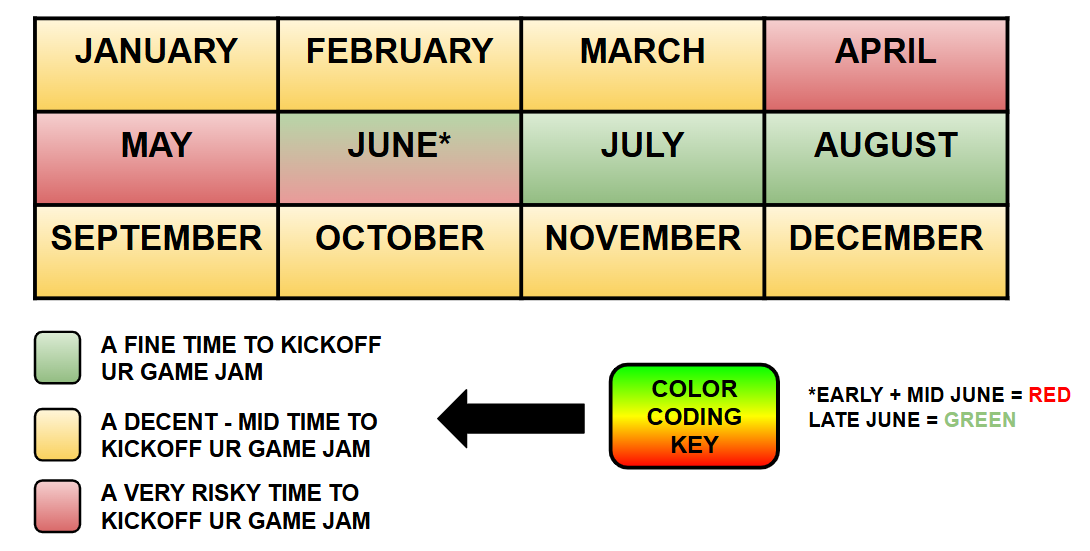
Now, in the chance that your game jam starts in Summer yet continues on during the midst of the school year, you’re going to have to tread carefully with your contestants’ personal life circumstances. There’s legit no definitive formula on how to deal with this as a host; usually, time/deadline extensions are useful here. But that’s stuff down the road.
Finding Your Contestants
Every competition needs contestants; you can write out the most professional-looking game jam announcement known to mankind on the internet, yet it ain’t going too far on its own if it doesn’t have anyone actually competing.
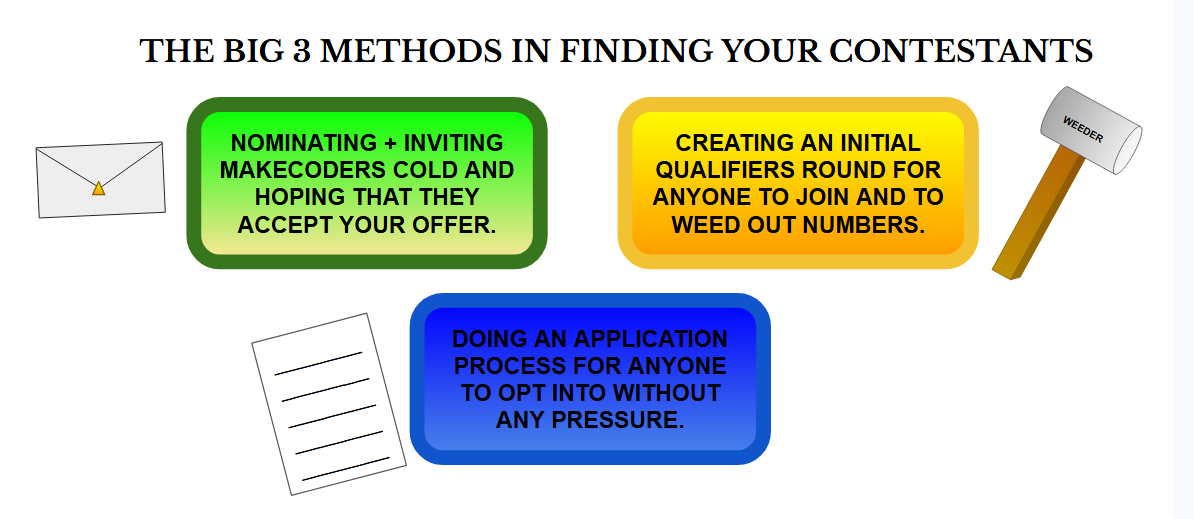
Now the question becomes: “How do I get contestants?” There is a good variety of methods. The option that I used myself was nominations in the Coder King series, where I passed out cold invitations to roughly 10 highly skilled and respected MakeCoders, hoping that they would accept the invitation/nomination to join the competition. Other MakeCoders could get an opportunity to enter if one of the nominees does not accept.
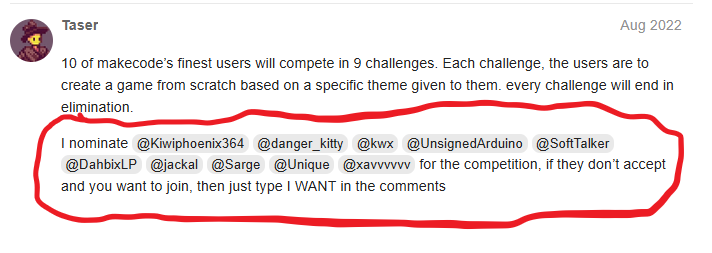
Now, for the aspiring game jam hosts who do intend to get contestants through the nominations method, I will say that they should try to focus on nominating the most active people on the forum since typically they are more likely to join and actually devote time into the competition. The less active people are not very likely to return to their primes just to participate in an unofficial game jam. It’ll be hard to say if they even read your topic at all.
You can also seek contestants through a qualifiers round where anyone on the forums is free to participate (and you eventually thin out the numbers for the best-of-the-best contestants); typically this is less of a hassle than waiting for nominees to type out their accept/decline response. However, the success of this method also depends on how much traction is gained for your topic and how you advertise/market your competition on the forums. After all, there is no guarantee that dozens of MakeCoders are going to make a project for your qualifiers round specifically; you gotta rope/attract them in first.
(↑ I’m referring to multi-stage game jams specifically here, but the same logic still applies to competitions scheduled to last for only 1 round and nothing more)
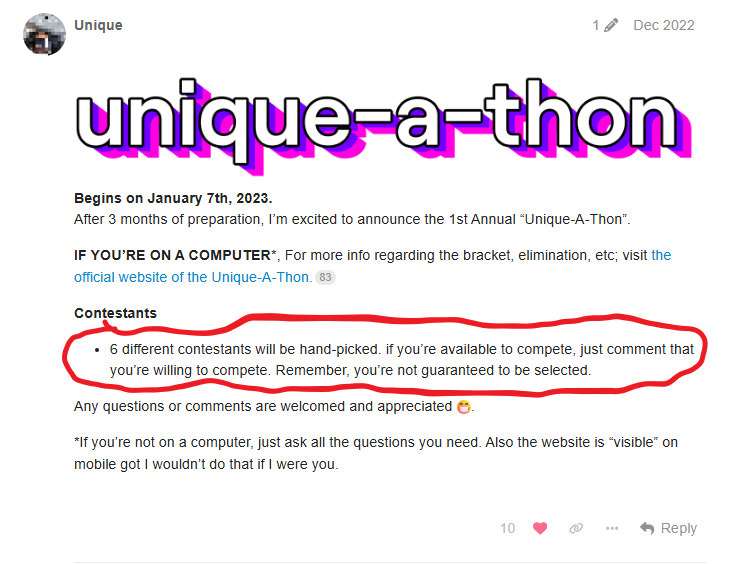
One could also choose to opt for an application/selection process, where aspiring contestants apply for a seat in the competition, and a select few are hand-picked for a spot based on chance (RNG) and merit (past experience on MakeCode). This is what @Unique in his UAT series did, and it worked out extremely well in his case. But, again, the popularity of your topic is probably the most detrimental factor in how well that goes.
Anyways, here is a quick visual that showcases all the yap that I said above.
Picking The Theme(s)
Now, before I start lecturing, I have attached a screenshot below; try to answer my questions, if you would please.
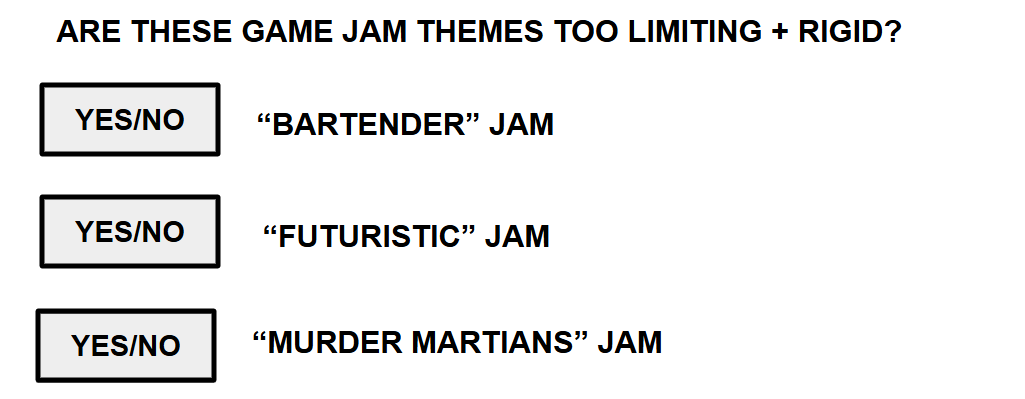
Hint hint: the only option that would result in an answer of “NO” in the above image would be the game jam with the theme of “Futuristic.” It provides the contestants with enough freedom to brainstorm their ideas; there is a variety of possibilities to think of regarding the far future: an utopia, robots, apocalypse/cataclysm, etc.
The other options are much too limiting and narrow in the POV of a contestant. For the “Bartender” jam, it becomes much harder to utilise creativity in a prompt like this since we would have whittled all the possible game mechanics down to serving drinks to customers; it’s quite difficult to think of anything else original. For the “Murder Martians” jam, I feel like it is plenty self-explanatory as to why it’s too rigid.
This brings me to the main idea of this section: in case you haven’t guessed already, the greatest prompts/themes are the ones that bring out the most creativity in people, and could potentially lead to interesting game ideas. Potential for originality + greatness is what makes or breaks a theme/brief in any competition in general.
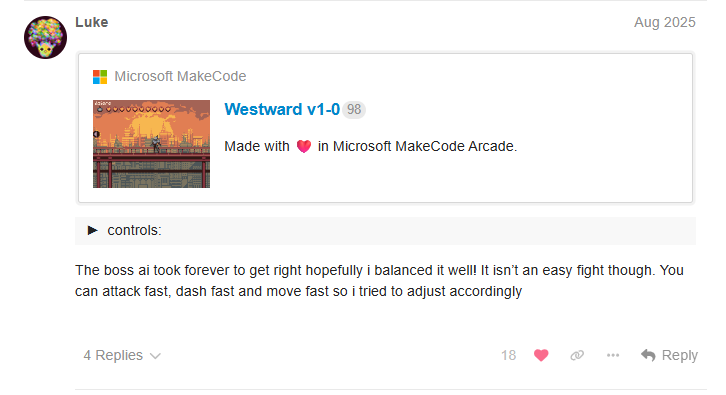
(This was for CK5 Qualifiers btw where the theme was “Western”, but rather than going for the typical Wild West theme, @Luke decided to make his game about going towards the direction West, a very unique interpretation with some fine execution indeed)
If you struggle to think of a good idea for a prompt on your own, you can try surfing the internet for past game jams and competitions (and their own themes) as inspiration. When you find something that looks + sounds fine on the surface level, brainstorm a few interesting ways that a contestant could interpret the prompt creatively. If your mind can’t think of at least 5 different ways of something, then that might be a red flag of a too-restrictive prompt.
Typically, the broader the theme/prompt is, the better it brings out creativity in the contestants. When you do decide on a broad theme, I would advise that you show your contestants examples of already-existing games that meet the brief. There are such cases (e.g., the theme legit being “chaos”) of a theme potentially being “too broad,” with the sheer amount of possibilities overwhelming a contestant rather than inspiring them, being quite self-contradictory when you look at it that way.
Balancing Your Extensions
Ok, I’ll admit that I did not handle this type of stuff the best when I look back on my CK series. I posted 2 screenshots from the CK3 (Coder King 3: Legends) topic for you all to see my example; pay especially close attention to the dates.


(still cringing about how I used to make announcements in my CK series)
As you can see from the 2 screenshots above, the challenge was initially supposed to end on 09/26/2023, but it took an additional month, to 11/01/2023, for me to actually finish it. This is definitely one of the more egregious examples of me abusing the “give extensions” tool as the host. I continuously moved the deadline forward again and again, and this led to the challenge taking way too much of my time.
This type of stuff was even worse in the CK4 topic, but I won’t elaborate too much on that fiasco to save as much face as humanly possible. Anyways, to put it all in a nutshell, I passed out way too many extensions like candy to the point where I actually harmed the processes of my contestants rather than improving them.

Anyways, my hopefully-simple advice for you all aspiring hosts of unofficial game jams is to be much more careful and attentive when it comes to giving out extensions. You should only do it when a contestant is undergoing urgent circumstances, like their only PC malfunctioning, preventing them from accessing MakeCode Arcade for a while.
Even when you choose to give out extensions, you want to make sure that you strike a balance with how long the extension goes. If it is too short (e.g., only 3 days), then that’s added stress for the contestants. Too big (3 weeks to a month) and it promotes procrastination with very little progress being made.

(Usually a 1 - 2 week extension is in the Goldilocks zone)
Really, I can’t find anything else to say about this part specifically, so let us move on.
Deciding The Deadlines
Every challenge and game jam needs an initial deadline/due date (before those extensions come rushing in); I really figure that this is common knowledge.
This really goes hand in hand with what I had just said in the “Balancing Your Extensions” section, where you have to strike a happy medium between what is considered “too long” or “too short.” Typically, a 1- 2-week deadline works very well in avoiding potential procrastination. Maybe 3 weeks wouldn’t hurt too bad, but giving an initial due date in 1 - 3 entire months is probably procrastination bait.
(yes, I’m reusing this visual)
Now, if you’re at a massive turning point in your (depends on whether it is multiple stages or not) game jam, like the grand finale where the champion is decided. Perhaps it can warrant a longer deadline, like at least a month (this is what I did in my CK series). But again, you are going to want to do progress checks on a regular basis to help bring down the procrastination levels in the contestants and make sure that there is actually stuff being done within that lengthy time frame.
Also, btw, if all your contestants submitted their games before the deadline was reached, you do not need to stand there for a few more days till the deadline passes; that’s boredom farming. You can feel free to begin the method of judging and writing up the results rather early.
The Art Of Progress Checking
When I start off this section, I think that it is pretty obvious why you are going to want to make sure that you are posting progress checks. Oftentimes, with no activity in your topic, contestants may gradually begin to forget or lose focus on what kind of stuff they are doing in the challenges. This also becomes prevalent if the initial deadline is very long, like 1+ months long.
It’s probably in your best interest as a host not to ping everyone for a progress check too often, though. Just look at it in the eyes of a contestant; imagine getting notified every single day while you are struggling and attempting to focus on your personal life circumstances and time devotion in your game jam; that’s going to get old really, really fast.
The most optimal times that you post your game jam progress checks depend on the deadline as well. For longer deadlines, you would want to space out the time intervals between each progress check, and perhaps you’ll have to resort to a wider quantity of posts like that. I would say that the rule of thumb for this type of thing is (see table below):

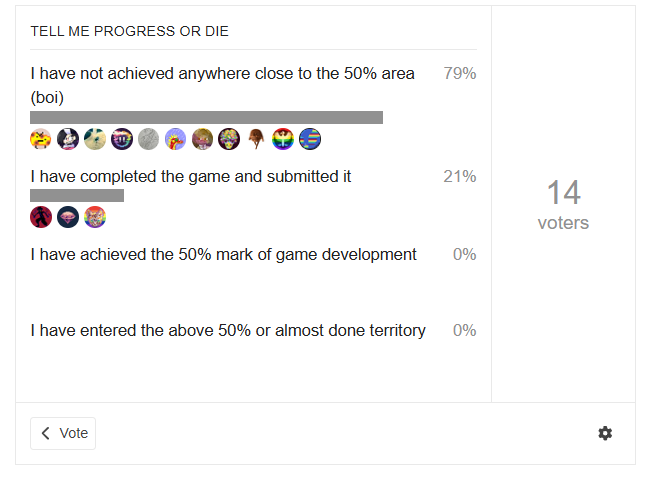
When you do progress checks, I find that an optimal strategy is to do a poll with each option representing a specific amount of progress that has been completed or something else. This method is extra convenient for everybody; the contestants don’t need to spend a ton of time detailing their progress in a separate reply/post when they could have used that time to develop their games further or do other things, and you no longer have to worry about someone’s progress while waiting for the mods to approve things.